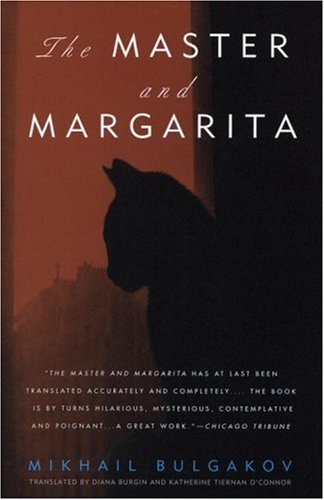
The description on the cover of the Master and Margarita tells us more about the content of this book than the typical description might. It begins “One hot spring, the devil arrives in Moscow, accompanied by a retinue that includes a beautiful naked witch and an immense talking black cat with a fondness for chess and vodka”. From reading this, I already knew that I was approaching a book that would be both unusual and magical. The devil does arrive in a Moscow that does not believe in either gods or devils, and the reader follows the exploits of his crew as they run amok. The book also contains the tale of Pontius Pilate who, although he sentences a prophet to death, still craves his companionship and redemption. The Master is a writer whose masterpiece is a novel about Pontius Pilate, and Margarita is his devoted lover. All three stories eventually intersect.
This book is absolut ely surreal, which is to be expected after reading the brief description. I re-read some passages, because I thought I must have missed something. The effect is fantastic. I get the feeling that each scene melds into the next – I’m as lost as the characters. I am left wondering whether man’s only peace can be found in death. Based on what I’ve read in the Master and Margarita, that wouldn’t necessarily be a bad thing.
One of the aspects of the book that I enjoy most is the way that the influence of anything foreign is portrayed. The devil as an unregistered foreign visitor in Moscow is very telling of the way that all foreigners may have been received in Soviet Russia. Characters in the novel are also fearful yet envious of foreign currency and those who possess it. I enjoy these subtle examples of the real social situation in a novel that is filled with magic and sorcery.
Overall, I enjoyed the book very much. It motivates me to learn more about this period in Russian history; I’m sure I missed many references that would have been obvious to someone who is familiar with the country. A book on Russian history would certainly add some diversity to my reading list.
This book is absolut
 ely surreal, which is to be expected after reading the brief description. I re-read some passages, because I thought I must have missed something. The effect is fantastic. I get the feeling that each scene melds into the next – I’m as lost as the characters. I am left wondering whether man’s only peace can be found in death. Based on what I’ve read in the Master and Margarita, that wouldn’t necessarily be a bad thing.
One of the aspects of the book that I enjoy most is the way that the influence of anything foreign is portrayed. The devil as an unregistered foreign visitor in Moscow is very telling of the way that all foreigners may have been received in Soviet Russia. Characters in the novel are also fearful yet envious of foreign currency and those who possess it. I enjoy these subtle examples of the real social situation in a novel that is filled with magic and sorcery.
Overall, I enjoyed the book very much. It motivates me to learn more about this period in Russian history; I’m sure I missed many references that would have been obvious to someone who is familiar with the country. A book on Russian history would certainly add some diversity to my reading list.


